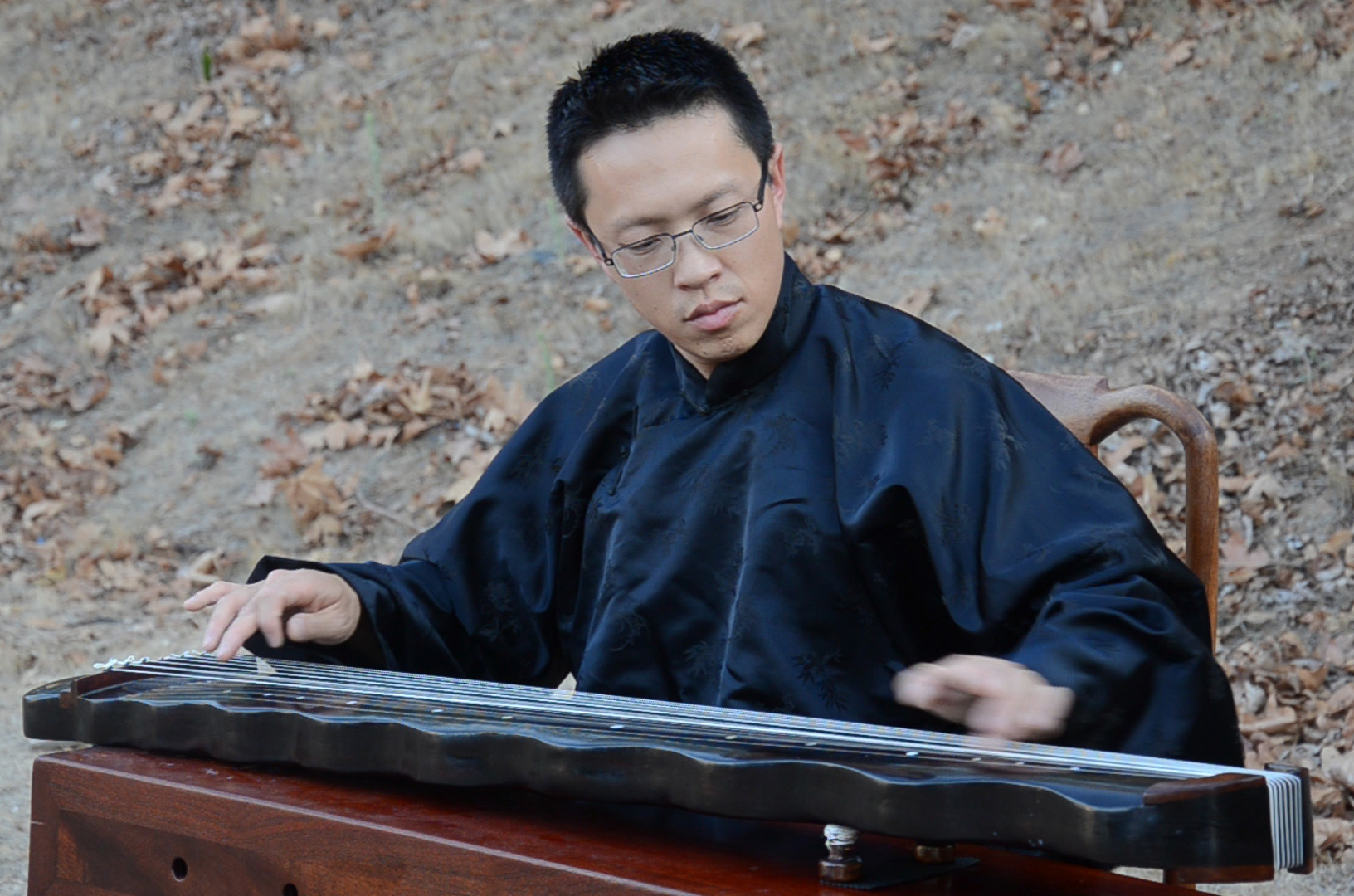
Tag: zither

  • The Boatmen’s Song

    The Boatmen’s Song

    The term “Ao Ai” 《欸乃》 originally appeared during the Tang Dynasty, in a poem by Yuan Jie 元結. As a guqin melody, however, this piece traces to 1549. Also known as the “Northern Fishermen’s Song” 《北漁歌》, the more well-known title “Ao Ai” is an onomatopoeia—it’s melody was written to conjure up sounds of oars and chants associated with rowing. Because of this allusion, several English translations call this piece “The Boatmen’s Song.”

    The song begins with deep sounds layered in glissando followed by pushing and pulling sounds in the lower register. Playful harmonics splash through the next several sections, interspersing the more serious mood with casualness. One of the more characteristic motifs is the repeated notes, switching between the tonic and dominant to mimic the cycle of rowing. This motif recurs in increasing complexity as the piece progresses toward a climax. Maybe it’s the rising wind and waves. Perhaps, it’s the frenzy of the catch. But in the end, the excitement disperses, giving way to calm.

  • Goodbye, ’Ma

    Goodbye, ’Ma

    My grandma comfortably passed away four days ago at the age of 90. The guqin piece below, Evening Call of the Raven 烏夜啼, is dedicated in her memory.

    * * * * *

    ’Ma was born April 19, 1924, the sixteenth day of the third lunar month, year of the Rat 甲子年三月十六, to my great grandparents—Chua ChingKee 蔡振記 and Tan AhYoo 陳阿如—in Chenghai 澄海, Guangdong Province 廣東省, China. My great grandma was from a family that sold cooking oil and exchanged currency, and she married my great grandpa, who dealt in the gold and silver foil business. On that spring day, he was 44, she was 36, and this was their ninth child.

    Grandpa had been in Thailand for business. It was 1939, and he traveled back to Chenghai to marry Grandma. On the fifth day of the fifth lunar month (June 21), word quickly spread that the Japanese had landed at nearby Shantou 汕頭 harbor. A few days later, Japanese soldiers were seen peacefully roaming the streets of Chenghai. Soon thereafter, they left town. But this would only be a brief hiatus. About a month later, the Japanese invasion took place full force; Grandpa fled with his second brother to the countryside, leaving Grandma with his youngest brother at home, tucked away in the attic. The whole town was pillaged—women taken away and men killed and burned. After the Japanese moved on, Grandpa returned to town, and Grandma joined him and his family.

    Shortly after marrying, Grandma stayed in China while Grandpa returned to Thailand. She stayed with his family, taking care of his mom while he sent back business earnings for support. They saw each other only several times over the next seventeen years. The Communist takeover in 1949 closed China’s borders, leaving Grandma to rear my mom and her sister (Auntie Julia) by herself.

    In 1956, Grandpa arranged for the family to be smuggled out of China through Macau on a small boat. Auntie Julia tripped in a pothole and started crying, causing the border police guards to take chase with their dogs. Then, by way of transfer through refugee camps, ’Ma brought the two small children safely out of China and finally to Bangkok to be reunited. There, she converted to Christianity, and both my grandparents became active members of the Chinese Seventh-day Adventist Church in Bangkok.

    For nearly the next four decades, my dad and Grandpa grew the family business. ’Ma would go along on business trips, many of which were in the Middle East. At home, my grandparents had four more children. Except for my mom, all five of them were sent to the Hong Kong and the United States to get the best education. In the meantime, essentially all of my parents’ and grandparents’ family business earnings went to support college tuitions.

    Support continued on after the move to Hong Kong and expanded to cover extended family left in China. Many of my first patchy memories of Grandma are from the days here.

    Five years later, we moved to Loma Linda, California. Aside from short trips, she’s lived here ever since. Until Grandpa passed away in 1998, they lived a life of generosity, spending most of what they saved funding local and overseas churches and supporting family and relatives back home.

    I’ve developed many fond memories. ’Ma introduced me to mushrooms stir-fried with soy sauce. She darned all my socks and knitted cozy blankets. Grandma loved her folding wooden pillow, even though they make soft ones out of goose down. She’s the best at eating fish head, and her dissection skills remained sharp, even up until recently. Then, a subdural bleed took away many of life’s simple pleasures. For her, it had become night.

    * * * * *

    At night, the raven’s call, often thought to be a bad omen, was considered lucky in Chinese literature associated with this piece. The melody is attributed to a Liu Song Dynasty prince, Liu YiQing 劉義慶 (403-444). In the year 440, Liu YiKang 劉義康 (409-451), Regional Inspector of Jiangzhou, was banished by Emperor Wen 宋文帝 (407-453) to the region where Liu YiQing happened to be governor. The two cousins were overjoyed to be reunited. This displeased the emperor, who ordered Liu YiQing to leave his post and return home. There, the family remained in fear of what might happen. One night, Liu’s wife heard the raven call, hearkening to an auspicious sign that he would be pardoned. That same year, after it really came to pass, he composed this piece to commemorate the good omen.

    * * * * *

    It is good that the suffering has now ended. On June 5, 2014, at 2:10 pm, Grandma breathed her last. ’Ma, bye-bye. Although things will no longer be the same, one day, we’ll meet again—’Ma, Grandpa, and all of us.


  • Flowing Waters

    Flowing Waters

    Launched into space in 1977, the Voyager Golden Record, with a rendition of Flowing Waters 流水 by Guan Pinghu 管平湖, flew past Pluto’s orbit, left the edge of our solar system, and entered interstellar space.

    My teacher, Lui PuiYuen 吕培源, reintroduced me to this piece. While dating to some time in remote antiquity, this rendition, with 72 gunfu 滾拂 rolls, is attributed to Zhang KongShan 張孔山 of the Sichuan school from the late 19th century.

    I find the middle sections the most interesting. Starting from the beginning, though, the opening measures seem to depict the grandeur of majestic peaks. Then, a flutter of harmonics, repeated in octave intervals, along with glissandi, conjure up images of a small trickle, perhaps from fresh snowmelt. Among the towering peaks, rivulets carve channels. They coalesce into a roaring river, with churning waters bursting the banks. Again, droplets of harmonic glissandi spray the listener who sits near the cascading stream. The music broadens as the river widens into an alluvial fan on its way out to sea.

    One of the most celebrated guqin pieces, Flowing Waters gained popularity early on. More than just evoking the churning of cascading streams down tall mountainsides, this melody more importantly alludes to a deep friendship that bridges social boundaries.

    In the Spring and Autumn Period (771-476 BC), a woodcutter from the state of Chu 楚 named Ziqi 子期 developed a close friendship with a literati named Boya 伯牙. Boya was a skilled guqin player, and only Ziqi was able to recognize the meaning of whatever Boya played. When Boya focused his playing on flowing streams, Ziqi exclaimed, “How vast like the flowing waters!” Whatever Boya played, Ziqi understood. When Ziqi died, Boya severed the strings of his qin, never to play again, because there is none other who can understand his music.

    兩千年來,民間一直流傳著這樣的故事:伯牙彈琴可以表現出他的『巍巍乎志在高山』或是『洋洋乎志在流水』。而他的知音好友鍾子期,完全能夠準確地領略到他的音樂表現。因此有伯牙作《高山流水》的傳說。據說唐以後將它發展為《高山》與《流水》兩個獨立的古琴曲。 《流水》,在近代得到更多的發展,特別是《天聞閣琴譜》中所載川派張孔山的《流水》。由於它充分運用了滾拂綽注等指法,進一步表現了流水中奔騰澎湃的效果。 —節錄《古琴曲集》。

  • Three Variations of the Plum Blossom Theme
    Three Variations of the Plum Blossom Theme

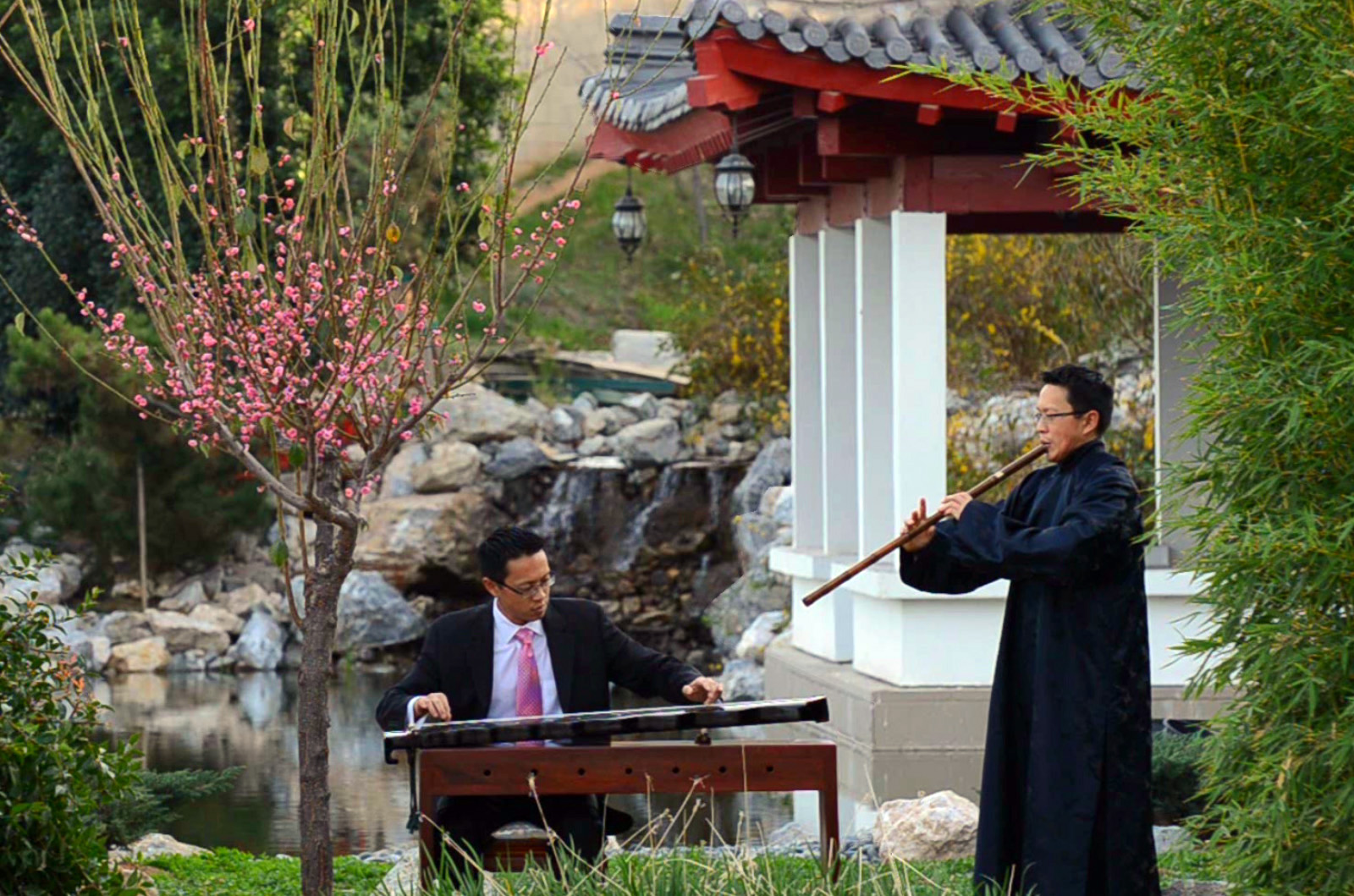
    The Chinese plum trees have burst into pink clouds over the past week, putting on a show of fully-double flowers. These blossoms make a perfect accompaniment for this wintry new year season.

    Over millennia, the plum blossom held captive the Asian imagination. Blooming in winter, it evokes the virtues of fearlessness of the bitter cold and endurance in the face of adversity.

    The origins of the Three Variations of the Plum Blossom Theme 梅花三弄 trace to the fourth century. Gaining popularity, the basic melody permeates the repertoire of most Chinese instruments. I had originally self-taught the guqin piece and played it after I finished making this guqin, but now I’ve learned it through this journey of formal lessons. As you’ll hear, the melody sections on the guqin are played using harmonics, each using different parts of the instrument and in varying octave registers and overtones. As the theme starts each time, I’ve chosen to depict ‘Peggy Clarke’ plum blossoms in the film. The introduction, middle sections, and end combine interlude material with parts borrowed from the melody.

    Last October, my parents brought me this flute from China, and interestingly, the name carved on the flute is the very same title of this song: 梅花三弄, or literally translated Plum Blossoms Thrice Played.

    Putting this melody together was most beautiful underneath an umbrella of petals in the garden.

  • Songs of the Fisherman

    Songs of the Fisherman

    This is the longest piece I’ve learned. Consisting of eighteen sections, Songs of the Fisherman 漁歌, like many other guqin pieces, portray the retreat to an existence that is immersed in the natural rhythm of the universe.

    The earliest printed version dates to 1546, and the associated original preface depicts Mao Minzhong 毛敏仲 leaving his official post, embracing the Dao, following the clouds and the waters, thus escaping worldly cares.

    Several versions exist. My teacher Lui PuiYuen 吕培源 gave me the transcription by Wu Zhaoji 吳兆基. Having studied the 1945 recording by Zha Fuxi 查阜西, I blended the two versions in this rendition.

  • Dialogue of the Fisherman and the Woodcutter
    Dialogue of the Fisherman and the Woodcutter

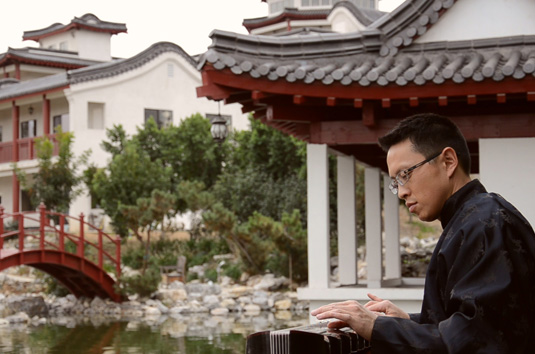
    While this melody is quite ancient, even by the time it appeared in print in 1559, Dialogue of the Fisherman and the Woodcutter 漁樵問答 remains a popular tune in today’s guqin repertoire.

    Two popular motifs are intertwined in this piece. The title clearly underscores Daoist themes—that one gains special knowledge by immersion in nature, in the world of the fisherman and the woodcutter. Here, Daoist ideals emerge: simplicity, humility, moderation, naturalness, action without action, and detachment.

    In an essay by Shao Yong 邵雍, the Woodcutter encounters the Fisherman, sets down his load of firewood, sits on a large boulder, and strikes up a conversation. After small talk about their livelihood, the two discuss cosmology, the yin and the yang, knowledge, philosophy, and worldview.

  • Flowing Spring of Jade Stream

    Flowing Spring of Jade Stream

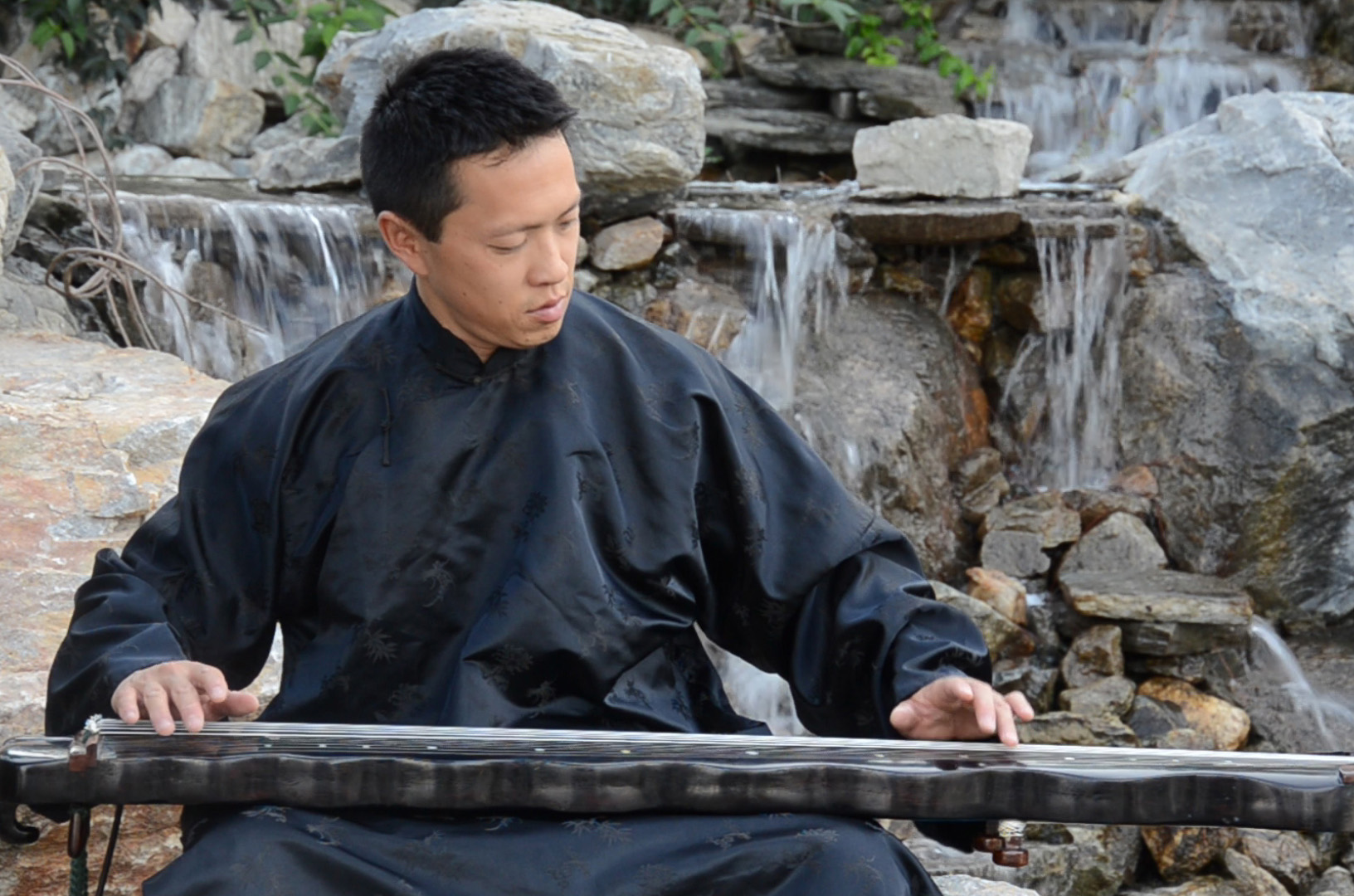
    Sitting on a large boulder by the waterfall, I recorded this ancient piece—Flowing Spring of Jade Stream 碧澗流泉. Like many guqin melodies that express motifs from nature, this one is supposed to evoke the mood of a gentle brook cascading over rocks.

    Normally accustomed to playing on a guqin table, this is my first time trying to play a piece out in a natural setting, with the instrument on my lap.

    The first part begins with a sliding note followed by a discordant dyad. The second part begins the first of three variations on a theme, each with increasing complexity and length. Between the second and last variations, the interlude of slides and hammer-ons suggest the playful flow of water.

  • Autumn Meditations at Dongting

    Autumn Meditations at Dongting

    This short melody, dating from 1549, depicts the fall season at Dongting 洞庭湖 in Hunan 湖南 province. This lake basin is fed by four river: the Xiang 湘, Zi 资, Yuan 沅, and Li 澧.

    The piece is divided into three parts, with the first and last parts in one key, and the middle part in another key that is a minor third above the original. No one really knows what the original key was really in, but in today’s convention, the piece starts in G major, cuts to B-flat, and reverts back to end in G.

    The guqin handbook 悟雪山房琴譜 describes the wistful meditations of this piece (with my translation).

    曾放扁舟泝楚天,
    清猿淚竹思淒然,
    廿年夢裏湘山月,
    今夜分明在七弦。
    I once set out a small boat under the skies of Chu,
    With tears and full of mournful meditations;
    In dreams the Xiang mountain moon now twenty years past,
    Clarity tonight flows from the seven strings.

  • Harmony of God and Men

    Harmony of God and Men

    Long ago, before there was Chinese writing as we know it, before we have the seven-stringed guqin, before the great flooding, a celestial being appeared and warned of the imminent danger. This account is attributed to Emperor Yao 堯 (c. 2300 BC), who received the celestial while he was offering a sacrifice. Being a zither player, he then composed this melody after being saved from calamity. His tune, titled Harmony of God and Men 神人暢, commemorates the celestial’s revelation.

    The earliest form of the guqin had five strings. Later, two higher notes were added to make seven strings. Played only on the lowest five strings, this melody heralds from that ancient time. Interestingly, this piece sounds nothing like what we think of as Chinese music, with its familiar pentatonic scale. The first, middle, and end sections are a study of harmonics, while the intervening passages explore open strings and stopped notes, even including accidentals. The tune finishes off with a perfect fourth dyad, as if from a time and place that is so far away.


  • Firmiana Leaves Dance in the Autumn Breeze

    Firmiana Leaves Dance in the Autumn Breeze

    No other tree conjures up as much literary imagination as the Chinese Parasol Tree (Firmiana simplex). According to tradition, it is only the Firmiana that the phoenix chooses to alight upon. The autumn season is closely associated with this tree, whose broad leaves turn to gold and drop, supposedly one leaf each day. Its lightweight yet strong lumber is used for guqin construction. The literary connection is found in many poems and paintings that stir up one’s imagination. In olden times, the Firmiana provides shade for scholars’ studies.

    Well, I haven’t seen any Firmiana trees growing around here. The closest setting is in a tranquil garden with a gentle breeze, shaded by willow trees and a stand of bamboo.

    Firmiana Leaves Dance in the Autumn Breeze 梧葉舞秋風 was first published in 1664. The up and down slides, along with the octave jumps, are supposed to evoke sweeps of cool breeze and leaves dancing. While the original tablature does not specify tempo or rhythm, the rather lively rendition played here is after the interpretation by Wu Jinglüe 吳景略.

  • Thinking of an Old Friend

    Thinking of an Old Friend

    This piece, YiGuRen 憶故人, Thinking of an Old Friend, is a relatively recent composition. Although melodically simple, the tune is layered in complex meaning. It starts out with harmonics that set the mood before delving into the main section. This part begins abruptly, as if with a flutter of emotions that repeat themselves. The elasticity of the rhythm and mood suggests wandering thoughts; the repetitious phrasing allude to how one, day and night, recounts fond memories, seemingly so close like yesterday, yet so far in the distant past. Unisons and dissonant chords hint at togetherness and separateness. The ending brings out emotional heaviness, emphasized by the drawn-out deep tones. As in the opening, harmonics echo the wistful sentiments and bring the piece to a close.