ARCHIVES

Tag: star trails

  • Center Basin

    Center Basin

    Kearsarge Pass | Center Basin | Forester Pass | Shepherd Pass | Shepherd Creek

    Part 2

    The lake is still, like a mirror in the morning light. Around dawn, I poke around with my macro lens to find suitable subjects, looking for details that often go unnoticed. Then, we have a simple but satisfying breakfast: oatmeal with honey , scones with pour-over coffee. I had made the contraption to hold the filter paper, and grounds were pre-measured from home: 35 g of beans to 560 cc of water.

    We set out under another bright sky. The wind starts to pick up as we hike around Bullfrog Lake. After heading down the Vidette Switchbacks, we reach the John Muir Trail along Bubbs Creek. There are a few overused campsites, and we try fishing from one of them. The hope is to catch some and grill them here, before we ascend above 10,000 feet where fires are prohibited. The one and only ranger we encounter on the trip greets us here and checks my permit. After lunch, we hike on.

    Halfway between Vidette Meadow Junction and Center Basin Junction, we stumble upon an impressive waterfall. Pictures don’t capture its majesty, especially in the glare of the harsh noontime sun. To our delight, though, trout are dancing in the large pool below the waterfall. There are maybe two dozen fish darting around. Brad and I decide to cast, and in the fast-moving current, without the chance to examine the fly, the golden trout strike at the caddis again and again. This is Brad’s first forage into fly fishing, and he’s enjoying the game.

    The trail up to Center Basin is non-distinct, but luckily, we met a pair of hikers who described how to find it: directly across from the campsite with a large bear box. The climb is difficult in places, and being unmaintained, we lose the trail in a few places only to wander back onto it. Cresting the ridge, an expansive basin greets us, Center Peak standing sentinel to the right, and the Crags palisading on the left. A lush meadow and shallow lakes spread out before us like a hidden paradise.

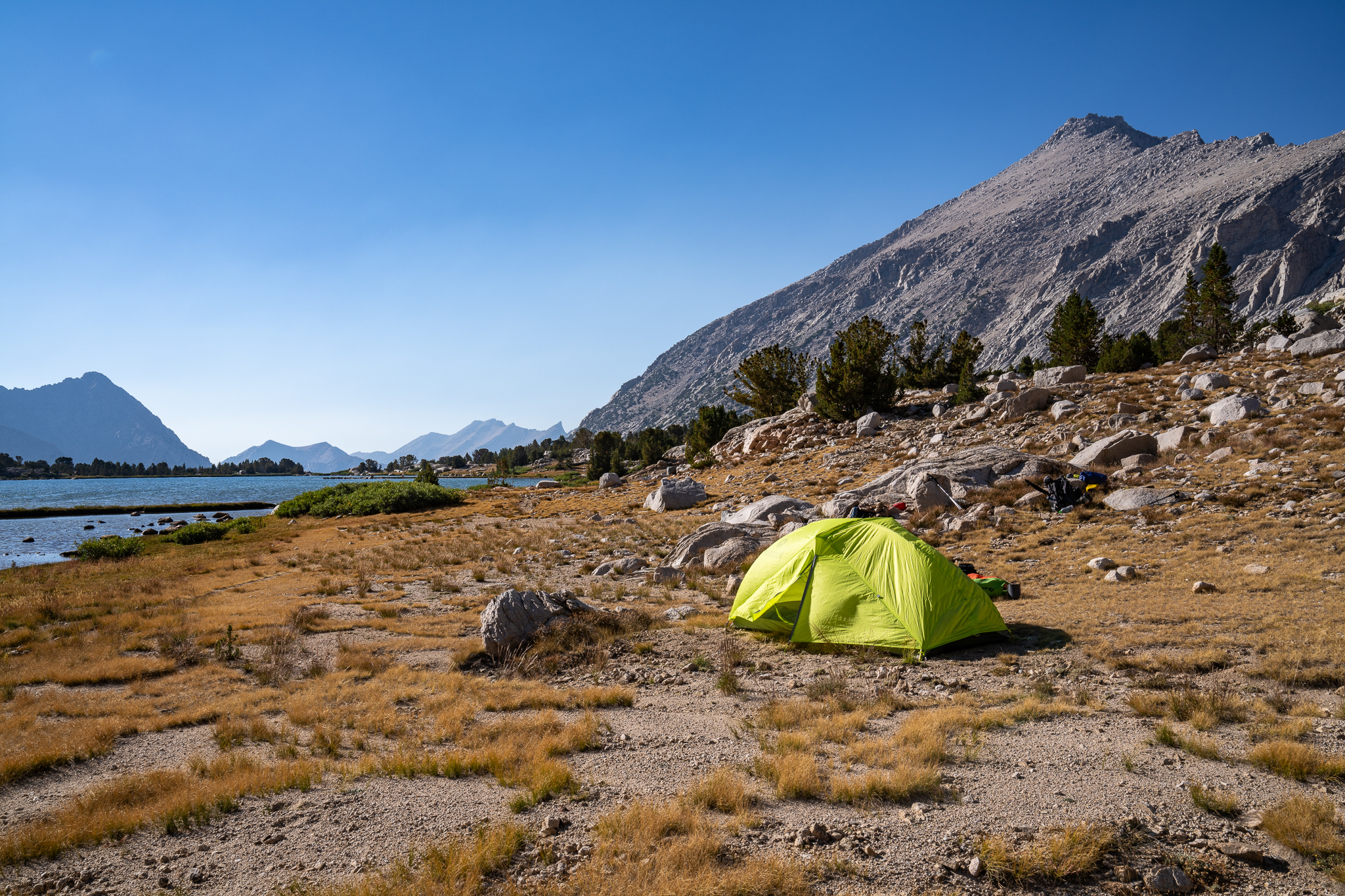
    We push up into the next basin, reaching Golden Bear Lake. The solitude here is deafening, and I feel like the mountains and earth are all touching the sky. Brad and I scout out a nice campsite; I like it because it allows for open views of the sky for star photography. With map and compass, I orient myself, pinpointing where Polaris will make its appearance tonight —just over University Pass.

    Following our usual routine, we set up camp, wash off the trail dust, and do laundry. Our shirts, shorts, and towels fluttering against the towering peaks evoke images of Tibetan prayer flags. Tonight’s dinner menu features spinach and cheese tortellini with pine nuts, Parmesan, and olive oil, finished with fresh basil. Fresh herbs are light and add so much to a backcountry meal. For dessert, Brad whips up tiramisu for a sweet treat to end the day.

    As the sun is setting, alpenglow emerges and paints the peaks in rosy hues. I set up my wide-angle lens and frame the tent and where I figured the north star will be. After a few test shots, I turn in, setting my alarm for 21:17, when dark night begins.

    The stars emerge and turn the sky into a brilliant tapestry. The moon is so bright it makes my test shots look like daytime photographs. I set the intervalometer and tuck back in; after an hour, I take my camera into the tent and drift off to sleep.


  • East of the Sierras

    East of the Sierras

    East of the Sierras | Lake Tahoe | Lassen Volcanic National Park | Central Valley | Yosemite National Park | The Lower Kern

  • Daphney’s First Backpacking Trip

    Daphney’s First Backpacking Trip

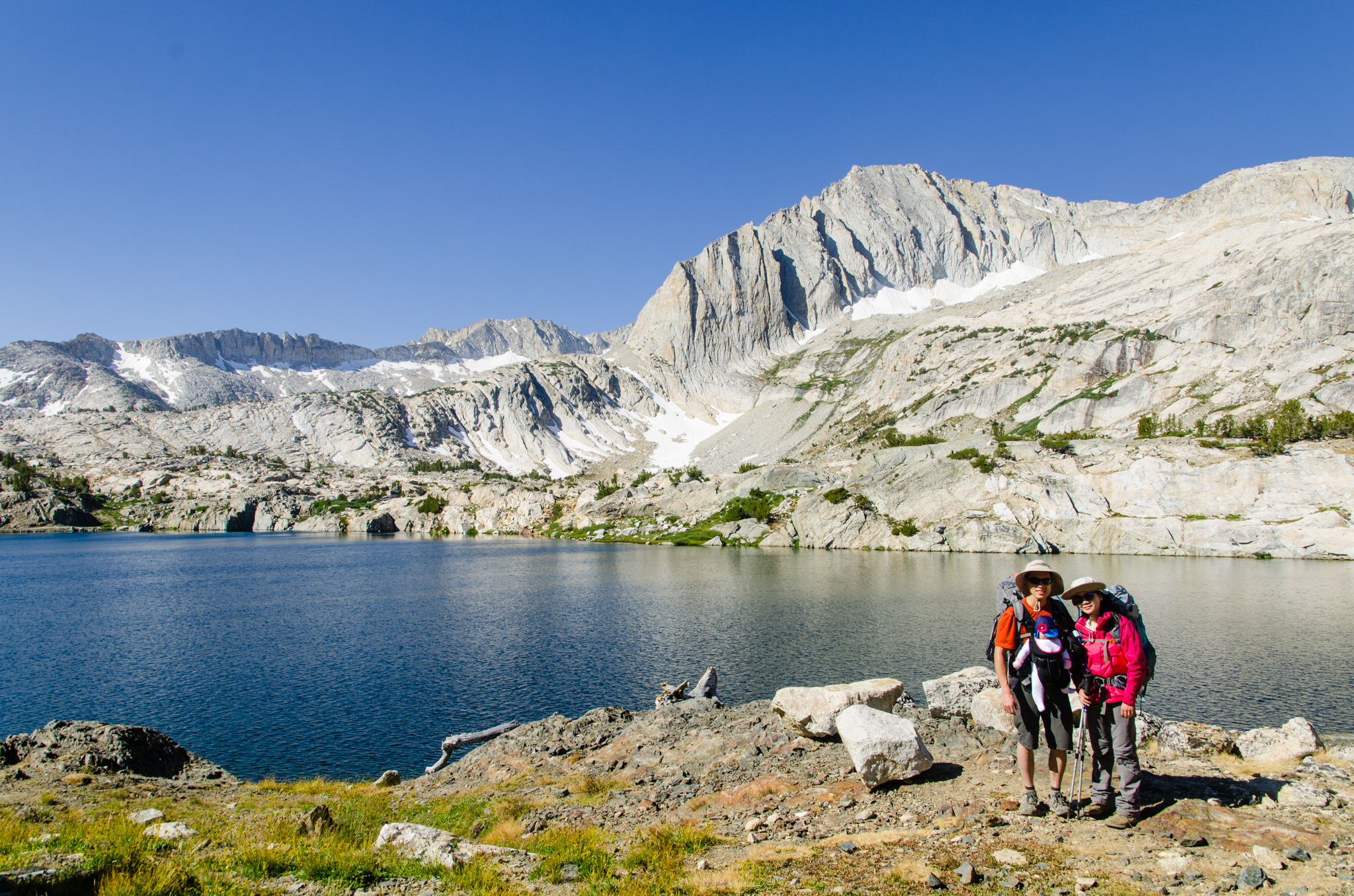
    Having successfully camped for two nights and hiked at high altitude, we figured it was safe to go backpacking. This will be Daphney’s first trip into the backcountry wilderness.

    We spend the first night at Gray’s Meadow to acclimatize. Situated just below Kearsarge Pass, the campground gives us perfect night sky to view the Perseid meteor shower. I wake up just after midnight. Yan barely arouses. I try again at 4:30, and this time, through the top of our mesh tent, we lose count of how many fireballs pass across the starlit sky.

    The next morning, we head out from the Saddlebag Lake boat launch and dam. On the other side of the lake on a grassy knoll, baby Audrey and baby Daphney get to know each other better. Beyond, we circle around the wrong side of Greenstone Lake but eventually make it to the highest valley; this is part of Twenty Lakes Basin.

    The group decides to set camp by Mill Lake. This picturesque lake is overshadowed by North Peak. We set up and wash. Daphney gets a chilly dip into the small waterfall from Cascade Lake. She’s not happy, but I warm her up and put on fresh clothes. Yan and I get ourselves warm with egg drop soup, rice, and red curry.

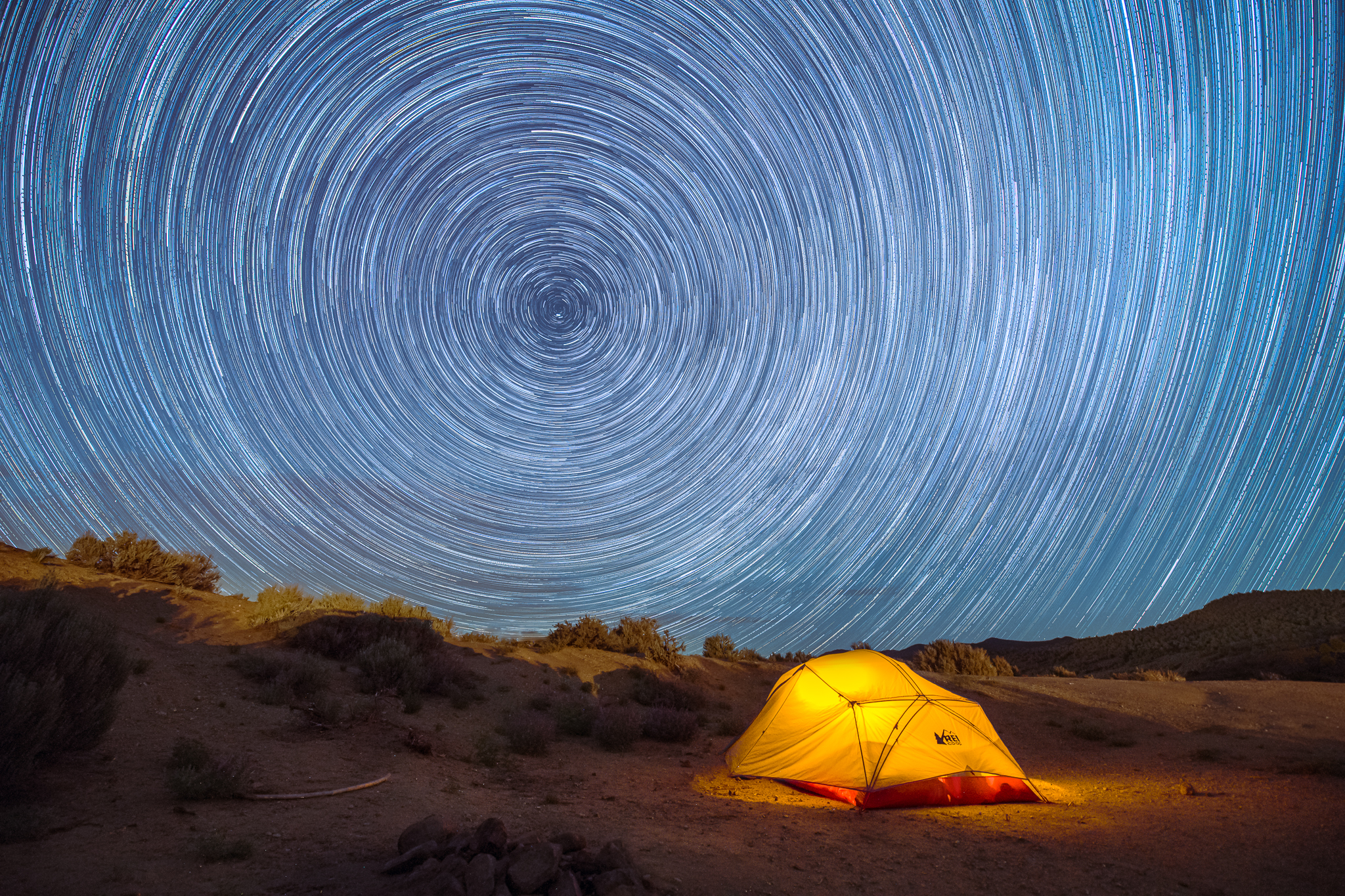
    As night falls, we turn in. The baby is fussy, and I’m worried again. Soon, though, Yan is able to console her to sleep. I’m outside orchestrating a tent lighting experiment. Some people’s lights are brighter than others’, so I have to call out when to shut off each one. After several tries, the lighting turns out evenly. My favorite shot from this trip would turn out to be the star trails over our lit tents.

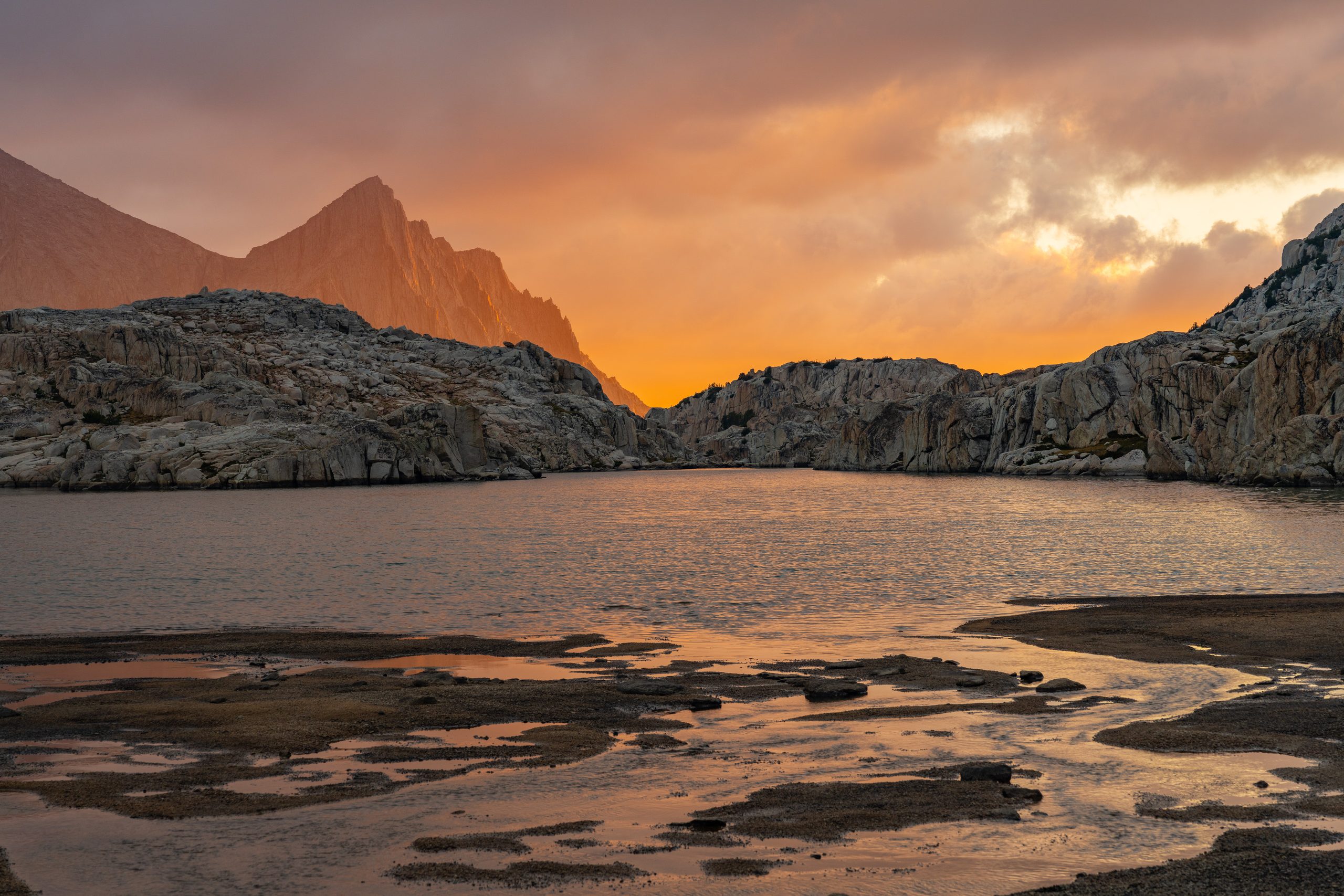
    The first rays of sun first fire up North Peak. Soon, the pools of water turn aglow with orange reflection as the valley comes to life. Daphney did fine, and she seems happy this morning. Yan and I have some hot drinks with oatmeal.

    The hike out seems longer. Maybe it’s because the baby feels heavier as the trail wears on. We get to take a nice long break at Shamrock Lake—this turns out to be one of my favorite spots.

    Before long, we’re back at the trailhead. A little hike along pavement brings us back to our cars. Daphney is still smiling, having gone on her first backpacking trip without ever wearing a backpack.

  • Joshua Tree

    Joshua Tree

    It’s been many years since my last climbing trip. I was a college student then. Now, my residents think that I can still do this, and Lucas set me up with gear.

    My main reason to go out to Joshua Tree was to get some Milky Way shots. But at this time of year, I would later discover, the brightest part of the galaxy trails closely behind the sun, setting just after the sun goes down. And besides, our campsite’s view of the Milky Way was blocked by a little hill. Nevertheless, the campfire and stars were beautiful.

    Some of the muscle memory came back in the warm-up climb. At the insistence of my residents, I attempted the 5.9, making it up the last dihedral through all the coaching—or, reverse coaching from my residents. Well, Mark said it was more like a 5.7, so I don’t feel so accomplished anymore.

  • Star Trails for Christmas Eve

    Star Trails for Christmas Eve

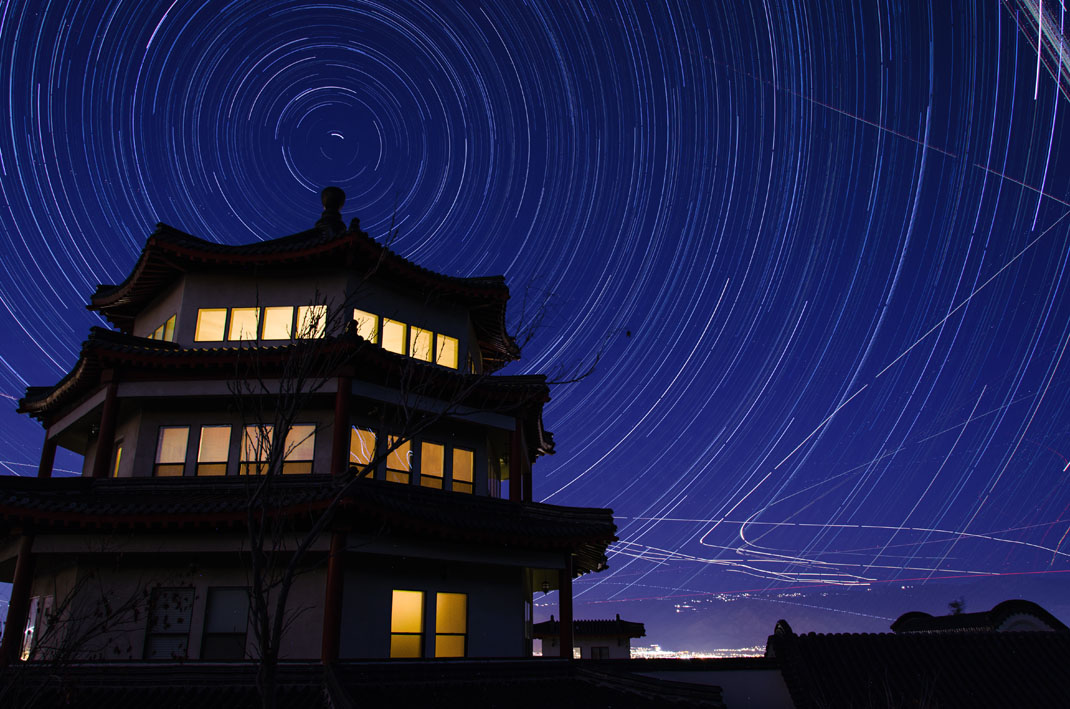
    For this Christmas Eve, I thought it would be interesting to post star trails taken from Loma Linda. Surprisingly, there were many more visible stars over lighted San Bernardino. Flight paths from air traffic in and out of nearby airports add some interest.

    This picture was captured last night from the south slopes, with settings at f/10 and ISO 400. Exposed over the equivalent of 255 minutes, the star trails arc about 1/6 of circle. One purposely underexposed shot was taken after sunset but before dark, then superimposed, so as to retain some foreground detail.

    Wishing everyone a starry merry Christmas Eve!

  • Mono Basin and Little Lakes Valley

    Mono Basin and Little Lakes Valley

    This first day of the trip, we arrive safely at the Mosquito Flat backpackers’ campground. Brad, Grant, and Max had gone up earlier to get the bear canisters and to pick up the permit, which was in my name, and Jeff and Jeong Mi rode in my car, leaving behind all cell and data connection; we’ll be unplugged for the next few days. We had met up in Bishop and had dinner at the pizza restaurant at the north end of town. Now at Mosquito Flat, we enjoy dessert of hot cider with dark chocolate. Grant and Max make a warm campfire, and soon, it starts to rain.

    The gentle drizzle continues for the whole night, and by the next morning, everything outside the tent is completely soaked. We organize all of the food according to the grid, and then we pack up and set out toward Mono Pass. Cloud cover cools our climb above treeline. Right at the Pass, we stop for lunch, and it’s here that Max starts to develop altitude sickness. We quickly cross over into Sierra National Forest, descend to Golden Creek, and then push on to Fourth Recess Lake.

    A tall waterfall feeds Fourth Recess Lake, which stretches out like a fallen leaf, the waterfall being the stem. Clean up feels so good after a long day of hiking. After dinner, we sit around sipping hot cider and watch the sky turn from blue to purple to black.

    Friday is a short day. The lake is a mirror this morning. After breakfast, we take the short hike up into Pioneer Basin. We decide to hike to the far end of Lake 2, where a beautiful lakefront campsite awaits. On this layover day, I hike up to the ridge just east of our private lake, and from there, I have a birds-eye view of Mono Pass and Fourth Recess Lake. Dinner tonight is tom kha soup with Thai peanut noodles followed by dark chocolate cheesecake.

    This wide open basin provides a great backdrop for night photography. The crescent moon sets behind Mt. Hopkins. Soon, stars emerge on the cloudless sky.

    We all get up early on Saturday, as we are nervous about making it back across Mono Pass. Again, Max feels the effects of altitude around treeline. After a short break at the drainage of Trail Lakes, we make the final summit push. We quickly descend to the meadow below Ruby Lake, where the boys take a nice long nap to recover.

    The original plan was to make it to Chickenfoot Lake, but now out of energy, we are glad to just settle down at Marsh Lake in Little Lakes Valley. This turns out to be a charming location—a small private lake lined with wildflowers. We make miso soup and curry with rice for dinner and go for a short walk to Heart Lake before turning in.

    On this last day, I am the first to get up to catch the first light. Again, this lake is like a mirror. Only a few of us have breakfast, some choosing instead to wait until we get into town. The hike out is much shorter than expected. After loading up the car, we drive into Bishop and have brunch at Erick Shat’s Bakkerÿ. On the way back, we stop in Lone Pine to return the bear canisters.

    The rest of the trip home goes smoothly. Along the way home, we all plug back in, and at the same time, remembering what it was like to be unplugged for a few days while making memories that will last a lifetime.

  • South Lake to North Lake: Day 3

    South Lake to North Lake: Day 3

    September 2

    This day would be the longest. I wake up to a beautiful morning. The air is crisp, the mosquitoes are gone, and my tent held up to the wind. I had guyed out Brad’s side of the tent to give more lateral headroom to the A-frame profile, and he says that it’s better. Hot coffee, although the instant variety, is surprisingly good on this cold morning at nearly 11,000 feet. Hot oatmeal is good too.

    Morning routine after breakfast takes me scouting out a spot with toilet paper in hand. I walk south to an area behind some trees and pick out level ground. From this vantage point, I can see the entire valley. Suddenly, I see trail, and I realize that it is the trail that we traversed the previous day. I have a clear view, and I am sure that anyone coming up the trail would have a clear view as well. Thankfully, it is too early.

    There isn’t much condensation on the tent, so packing up is easy. We follow the trail and end up scrambling up a large boulder pile before realizing that the trail had actually crossed the creek. We backtrack, and soon, we head up the trail toward Muir Pass. A high alpine meadow rests on the plateau overlooking Lake 10880. Then, we climb above treeline. Helen Lake is a beautiful, deep blue body of water rimmed with bright snow. We have a little snack here.

    The last little push to the pass takes place over mostly snowfields with well-established tracks. Muir Hut comes into view. From here, the desolate northern expanse looks like moonscape dotted with blue gems, deep lakes made up of snowmelt. We spend a lot of time checking out the Hut, taking pictures, and having lunch. After we finish, several groups of hikers arrive from north and south. It becomes a crowd, and we figure that it must be time to leave.

    We pass by large Wanda Lake, then Sapphire Lake, and finally stop at Evolution Lake inlet for another lunch break. The noontime sun beats pretty hard in this high environment, and we almost overheat. Brad washes his face and bandana, and I dunk my head in the cool stream. We also refill our water containers for the trip down from here.

    Evolution Lake twists, turns, and tucks among boulders, rock piles, and peninsulas. It takes us a long time to reach its outlet. From here, we start our descent to Evolution Valley. We rest on a large slab of granite with an open view of the valley. Brad takes a nap in a gently-contoured spot with a rock pillow. Staring down from here, it’s like flying, lifting off from the mountainside.

    The trail flattens out at Colby Meadow, and we soon arrive at a large campsite in McClure Meadow. It’s a nice site, but we figure that we can find better. We walk further down the trail, pass a site that is closed to restoration, and come across another place. There is already an orange MSR tent pitched there, so we walk around and beyond it to a large flat spot. A large clean granite slab forms a low ridge between the site and the river. This proves to be a perfect spot. A few steps away from our campsite, one gets the best view of McClure Meadow and the rugged ridgeline of the Sierras in the background. I am happy we ended up here. Brad is happy that we finally found a spot and can now settle.

    Tonight’s dinner is Tom Yum Soup and Thai Peanut Noodle. The fresh lime makes such a difference. We both agree that Asian meals tend to work better. While we have dinner, the mosquitoes have theirs. Brad puts on his bug protection, complete with a netting hood. I’m nearly immune. Because we are now lower than 10,000 feet, we are allowed to have a fire. Brad builds a small one right on the granite slab. The ambiance is nice. We have dark chocolate cheesecake for dessert along with hot chocolate spiked with cayenne pepper. My camera takes star trail pictures while we sit and talk around the fire.

     
  • South Lake to North Lake: Day 2

    South Lake to North Lake: Day 2

    September 1

    A dusting of frost covers nearly everything. I first notice this on the backpacks just outside the tent. My towel is frozen stiff. There is bad condensation inside the tent because it’s so cold outside. The cure, of course, is a nice helping of hot coffee. Starbucks Via. Being in charge of the rest of breakfast, Brad measures out servings of oatmeal and dried mix of almonds, coconut, and an assortment of berries. Yes, the caloric allowance has been accounted for.

    After loading up the packs, we head down into LeConte Canyon. The Black Range forms a wall directly in front of us across the canyon. Dusy Branch cascades alongside our descent, and the large waterfall right after the footbridge presents us with many photo opportunities.

    Soon, we reach the junction with the John Muir Trail. We register ourselves. We hike through scenic Little Pete Meadow and then through the forest cover at the edge of Big Pete Meadow. Switchbacks take us up toward Muir Pass. We meet hikers coming from the other direction, and I ask some of them about conditions. Helen Lake is too frozen to stay at, and I know that there are campsites at an unnamed lake just below that.

    We arrive at Lake 10880. While there is a very nice peninsula at the lake’s outlet with great campsites, the biologists have deemed this area to be a frog protection zone. We find our site on a high ridge overlooking the outlet stream. Behind a big rock pile, a small trail leads to the edge of a bluff facing the canyon.

    This night’s dinner would turn out to be the worst of them all. The black bean soup is tasty, but I will soon conclude that watery soups are much better in the wilderness. The post-dinner routine is pretty much the same—cleaning, hot drinks, dessert, putting away food.

    Brad and I decide to take a stroll along the lake. We sit at the peninsula’s edge watching the sky turn from blue to purple to black. Brad plays music from his iPhone, something you normally try to get away from while seeking wilderness. I tell myself that technology is OK; after all, I did bring a heavy digital camera.

    Setting up the camera, I find a very nice spot just south of our tent, between camp and the high bluff overlooking the approach trail. From here, the view of the tent and the granite ridgeline across the lake are clear. The Big Dipper, with the ladle handle pointing westward, and Polaris come into plain view. I take a few test shots while asking Brad to flit the headlamp around inside the tent to bring even illumination. After getting everything set, I turn on the intervalometer and let my camera click away on multiple 30-second exposures. The plan is for a total of one hour—pictures to stack together as star trails.

    The wind whips around our tent, and this wakes me up. Not being able to sleep, and thinking that the camera is finished, I venture outside to check. It has only been about 45 minutes, but now, I’ve ruined that exposure because of my headlamp light. I figured it would be fine to stop it here, and I bring the camera inside the tent.