ARCHIVES

Tag: 與古齋琴譜

  • Portland

    Portland

    Arriving in Portland on Tuesday gives a slow transition to the next part of this extended time away. Activities for the Western Orthopaedic Association starts on Wednesday.

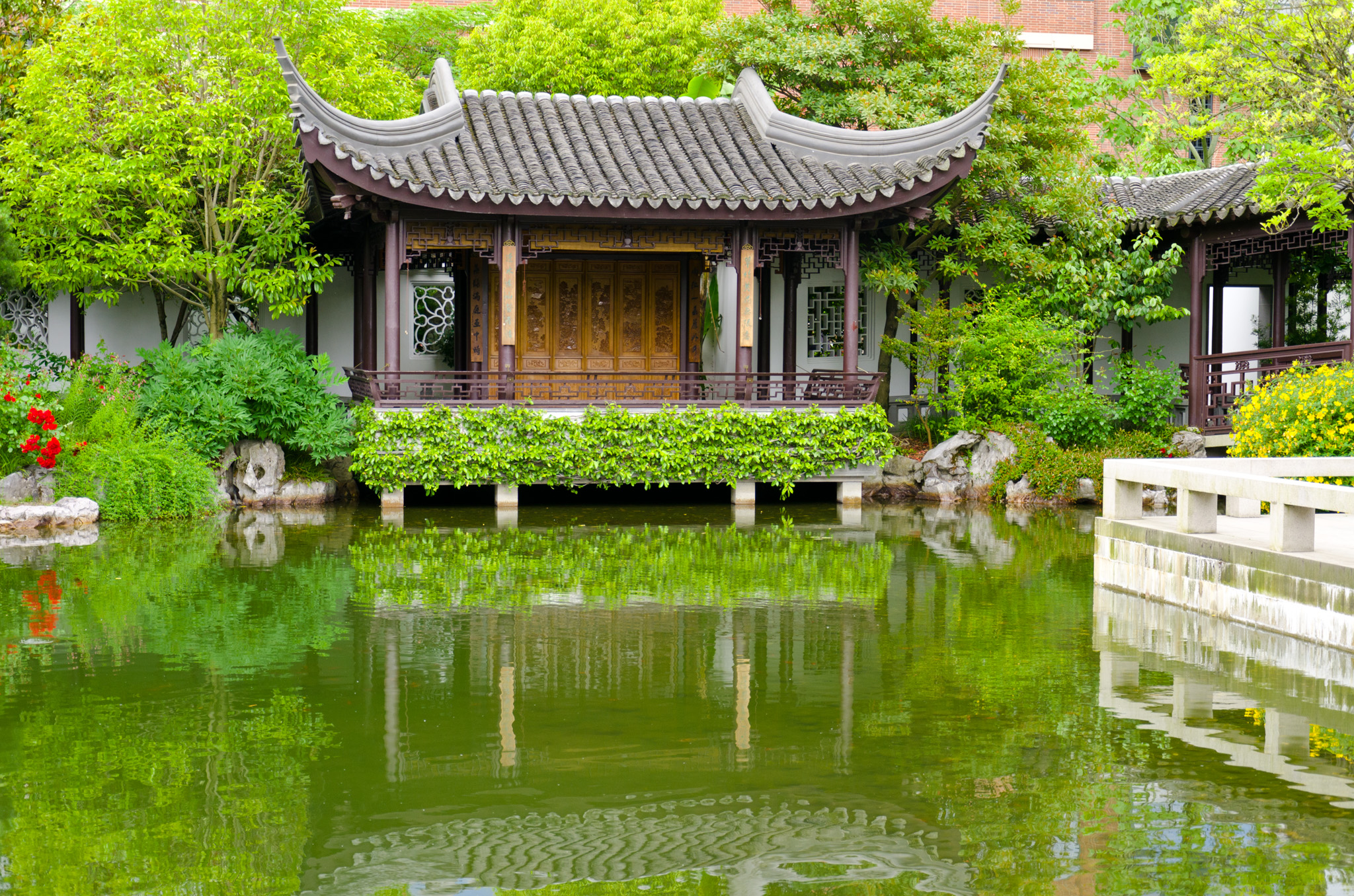
    I spend most of Wednesday morning touring the Portland Chinese Garden 蘭蘇園, taking time to follow the self-guided tour explained in the brochure. For the last stop, I have chili bamboo shoots, seasoned tofu, and tea eggs at the quaint tea house overlooking the Zither Pond. I also meet Dr. Yang JiYu, who performed the erhu for me. He wanted to write me some calligraphy, and he asked me to pick a poem.

    On Geese Turning Back 歸雁
    Why do they turn back when they reach the Xiao and Xiang?
    The water is green, the sand is bright, and both shores are mossy.
    Twenty-five strings echo beneath the moon at night;
    Unable to bear such melancholy, they all fly away.
    瀟湘何事等閒回
    水碧沙明兩岸苔
    二十五絃彈夜月
    不勝清怨卻飛來

    Afterwards, I meet Jim Binkley at his home. He talk about the guqin, and he shows me his workshop. It was through his translation of the 與古齋琴譜 that I was able to construct the instruments.

    Then, there is the Orthopaedic Research & Education Foundation (OREF) event that first day. As always, it’s good to renew friendships.

    The main meeting starts on Thursday. Chad’s poster is up. The Howard Steel lecturer weaves a captivating story about the Lewis and Clark expedition from the point of view of medical care. After the meetings, I drive out along the Columbia River Gorge and take the scenic route from Horsetail Falls, beside Multnomah Falls, and ending at the Portland Women’s Forum. I return just in time for the outing to the World Forestry Center for the dinner reception.

    Friday is similar, with most of the meetings ending by early afternoon. The healthcare policy talks are interesting.  Then, Barth and I drive down to Silver Falls State Park and do a scenic 10-mile loop hike—Trail of Ten Falls, including side trips on spur trails. This place is a photographer’s paradise. We end up being late to the gala event.

    I had originally thought I could do the 17-mile Benson Ridge to Eagle Creek loop, but Sabbath morning is lazy, and I make it to the trailhead at 11:00 after taking pictures of Barth presenting his paper. Instead, I hike the Eagle Creek trail, out-and-back to Tunnel Falls. Several areas of vertiginous cliffs are fitted with a mini version of the via ferrata. Although it’s more about the journey than the destination, Tunnel Falls is quite the climax. There, I cool off in the fall’s spray. On the way back, I watch guys jump into Punch Bowl Falls and survive.

    On my way to the airport this morning, I stop by the Oregon Museum of Science and Industry (OMSI). The most interesting is the demonstration of probability theory and the Gaussian curve; set up like a pinball machine, I think this is the best illustration I’ve seen. The ferrofluid station on nano materials is fascinating. There is also the National Geographic exhibition, titled Ocean Soul, featuring the works of Brian Skerry. His underwater photography is breathtaking and inspiring at the same time.

    Back in California, I step off the plane to 93°F temperature. After being away to the northern latitudes for nearly two weeks, welcome back to Southern California.

  • Guqin Lessons

    Guqin Lessons

    After constructing three instruments, I finally started taking formal guqin lessons—from Lui PuiYuen (吕培源).

    This all came about in an interesting way. More than ten years ago, I found the 與古齋琴譜 (Abiding with Antiquity Guqin Manual, 1855, tr. Binkley) on the internet while looking for construction details. After making my first one, I decided to improve on the design, and in 2010, I was inspired to make two more instruments. I kept a construction blog, including an album of the entire process.

    Jim Binkley, who translated the 與古齋琴譜, found my blog and wrote me with some questions. He now teaches computer science at Portland State University. I also asked him if he knew of any contacts in Southern California, since the guqin is a relatively obscure instrument. He said that one of the best players still alive is Mr. Lui, and that I might contact one of his former students, Alan Yip, and get connected.

    After meeting up with Alan and later with Lui Laoshi, I started my first lesson on April 22. The curriculum started with 仙翁操 and 湘江怨. The next lesson included 古琴吟 and 秋風詞. Now, I’m working on 歸去來辭. Many of these are based on ancient poems.

    I’ll try to post recordings when I get a chance.

  • Tuning the guqin

    Tuning the guqin

    I’m basically done!!!!! And the experiment with the compound radius worked out well. The main aim in making the new instruments was to try to eliminate string buzz, and indeed, it’s gone.

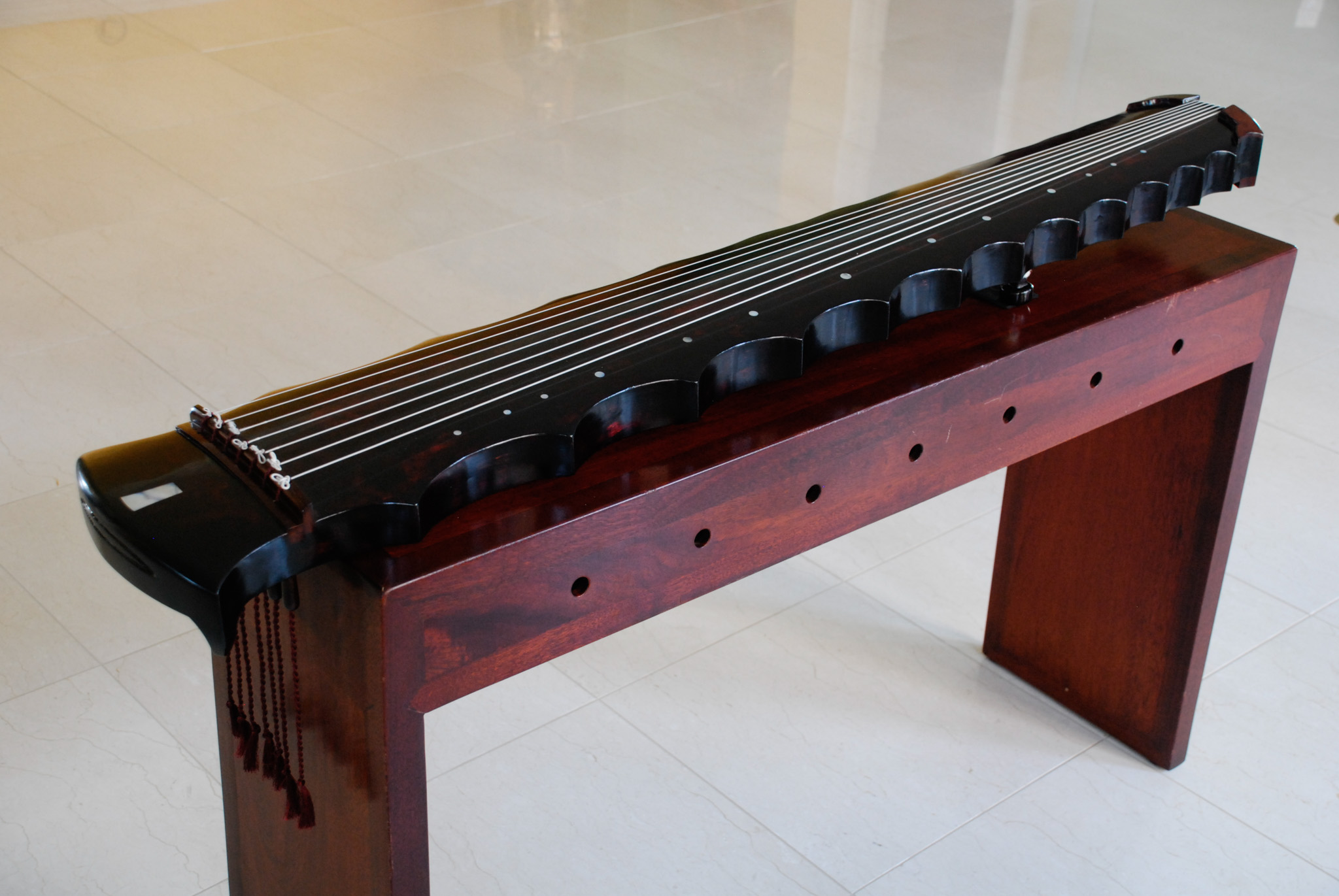
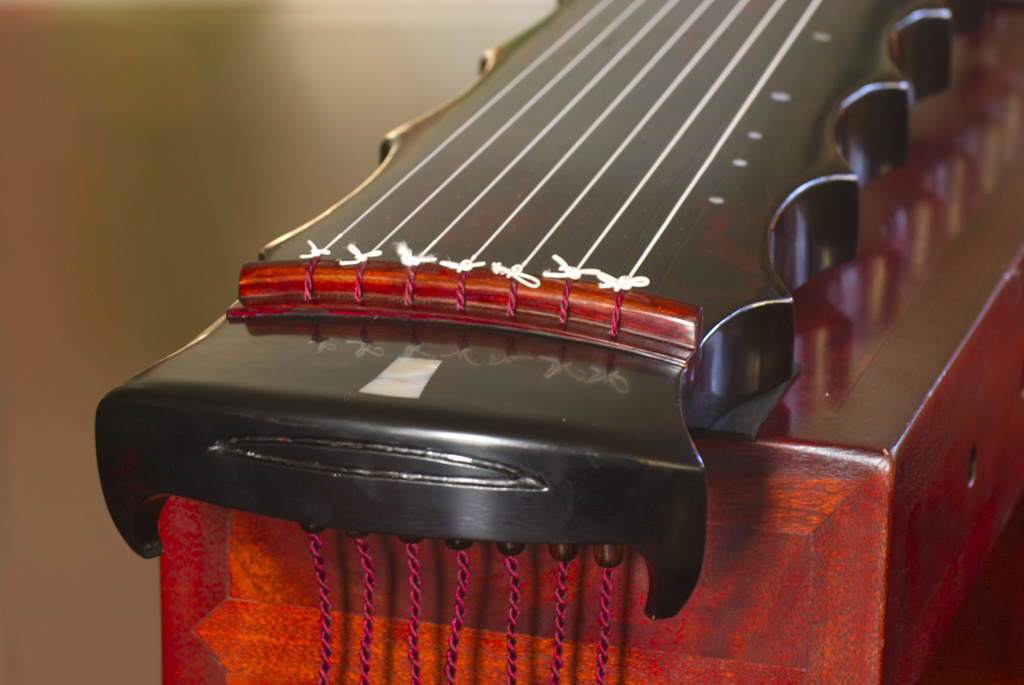
    Making the tuning cords required some trial and error. I bought tread, and for this luoxia guqin, I mixed two colors—maroon and brown—to match the multi-toned color on the instrument itself. According to 與古齋琴譜 (Abiding with Antiquity Guqin Manual, 1855, tr. Binkley), red is vulgar. After trialing different combinations and twists, I settled making the first ply three feet long using 32 strands each of maroon and brown. Then, I put in 120 right-helical twists by attaching it to a drill and running it in reverse. Once it was doubled upon itself, the plies wound into a nice left-helical cord of 128 individual threads. I threaded these through the tuning pegs with the aid of some copper wire.

    Bringing the instrument up to correct pitch proved to be a challenge, because tension in the string has to be maintained while wrapping it around the feet. On Thursday, while trying to put on a string while keeping tension, everything slipped, and the tension hurled the guqin toward my forehead, making a deep gash right in the middle. After several attempts, I came up with a device to wrap the strings; this I made out of an old piece of cherry baluster.

    Playing on the new instrument was a delight. The nut ended up being a little high, so I took the strings off and carved away some of the jatoba wood. Once the finish dries, I’ll replace the strings.

  • Inspired to recreate the guqin

    Inspired to recreate the guqin

    For the last month, I’ve been practicing the guqin 古琴 a little more. In time for the Prunus mume that opened and faded, I finished learning 梅花三弄 (Three Variations on the Plum Blossom). Now, I’m working on 流水 (Flowing Water), which is significantly more difficult.

    Anyways, I got inspired to make another guqin. The one I’m playing on was made ten years ago based off of 與古齋琴譜 (Abiding with Antiquity Guqin Manual, 1855, tr. Binkley). The main problem with it is that there is string buzz when playing the lower notes at the end of the soundboard due to a progressively smaller string-soundboard angle. To deal with that problem, I mathematically modeled the descriptions from the Guqin Manual with modifications, interpolated surface curvature, extrapolated the dimensions of the bridge, figured equal string spacing along the bridge curvature function, and added a compound radius to the length of the instrument to keep the angle constant in the tail end. And instead of cutting out the pattern in 1/16-inch increments, I am using 1/32-, 1/64-, and 1/128-inch depth changes depending on the location. Hopefully, this works out better.