
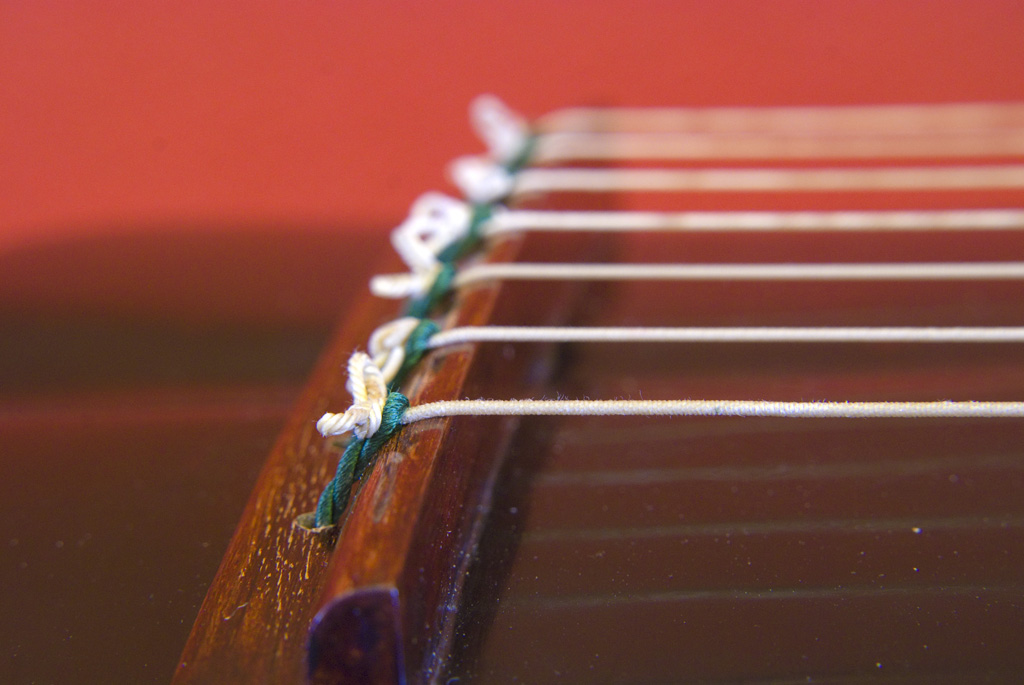
The tuning cords have been twisted and thread through the pegs. On one, I used modern steel/nylon strings, and on the other, I used silk strings. They sound very different, and I’m pleased with how both instruments turned out. Now, I have to try the pick-up system in the jiaoye guqin with the silk strings and hear how it sounds.


Comments
20 responses to “Guqin Tuning Cords and Completion”
I have been researching guqin recently, the photos of qin construction were well done… how did you design the template overlay for the cuts, also … for the routering ? I would like to make my own qin (although I am thinking of using nylon strings
Thanks for the comments.
I read the instructions from Yuguzhai Qinpu (Abiding with Antiquity). There’s an English translation by Jim Binkley who lives in Portland, OR. Basically, the instructions are in words (draw a straight line, mark off 12 divisions, inscribe a curve, etc.) I translated that into math and just plotted it. But, I deviated a little but and tweaked the formula to get a wider instrument so I can play with the profile. Then I drew lines on the boards and routed away. I think I was too detailed, and if I do this again, I would make less contour lines. It was too tedious. Do you play, and where are you located?
Thanks for such a fast response… I have just started reading the book Yuguzhai Qinpu (Abiding with Antiquity) now… 🙂 I am at the very beginning in this pursuit … but I have heard that a long journey begins with but one step… 🙂 I will try to duplicate your method of translating into math formula… do you mind if I consult with you if I run into problems?
That should be fine. Let me know whenever.
By the way, which city/state/country are you in?
(I’m working on restructuring my blog, so links might change. You should be able to re-navigate back through my homepage.)
Hi Danny,
What software did you use to plot the template? Also… which do you think is better, the silk string or the nylon/metal string…
appreciate it… currently in Dallas area, Texas
Calculated contour lines and just plotted them x-y. Any simple program will work. Silk is very painful to deal with. The sound is rough. It goes out of tune constantly. Do you play?
thanks for the tip about silk strings… it saddens me to hear it though… I listened to “Wild Geese Descend On a Sandbank” played using silk string, and again using metal/nylon string… while not as loud, there was distinctive overtones… the research I did said the silk string last about 7 years… good sound between years 2-5… normally breaks at the point of contact at the bridge… extend life through splicing in more silk string at the point of breakage…
I am literally just beginning… doing my background research first… studying the structure of the instrument…
Hi Danny, as I slowly inch forward in my understanding of matters related to guqin… I noticed you are using a transduction pickup… why did you go that route? I have another question… did you vary the depth of the wood to accommodate the thickness of the string above it… thicker under the lower tone… thinner under the higher tone? I read this technique is used to facilitate the transmission of the formant frequencies into the sound chamber…
I happened to have that pickup from another instrument, so I just transferred it over. No other reason in particular.
About the thickness: guitars have struts, and violins have the bass bar. In the guqin, because the design already calls for wood to be left thicker across from the soundholes, I didn’t vary the thickness.
Hi Danny, I’m in Kunming now getting ready to begin building my guqin.
My son gave me an older version of Mathcad his teacher had around so i will that for the calculations. I’ve been learning to play the guqin in Kunming 🙂
I changed out the strings on my qin… the silk strings are much easier on my fingers and I like the sound more than the steel strings…. i coated the strings with candle wax and rubbed the wax into the string using a cotton cloth before using them… the first two weeks I had to adjust the strings constantly as they stretched out… however, after two weeks they settled in… several months now… they don’t change at all…
what kind of wood did you use for the bridge?
Hardwood, like jujube or rosewood. I just met with Jim Binkley and had a nice talk. He and several other makers and I agree that the author of Yuguzhai probably never made a guqin.
Hi Danny, I hope to start construct my Guqin within two months… I have been gathering supplies and tools… I just finished playing 阳关三叠… I would appreciate your feedback on my playing… It is only 1.6 meg… Can I send it to you?
Sure. Just e-mail me. Are you in Kunming or in TX?
wongworawat@gmail.com
Hi Dr. Wongworawat:
What was the inspiration/impetus for using fiberglass mesh as a soundboard protectant instead of the more traditional mud? I find that aspect of your work along with the meticulous attention to detail intriguing.
Hi Thomas,
The traditional material was not mud, but rather, the sap from the lacquer tree, which is related to the cashew and poison ivy. The compound, urushiol, undergoes oxidative polymerization to form a plastic-like material (you can look up the compound urushiol online). Then, to give it more durability, the ancients used deer horn powder and other additives, like rust water and bile juice. I am by no means a purist. If the ancients were here today, they would probably look for a modern equivalent for the urushiol. I chose epoxy polymer. And instead of going out and finding deer horn and rust water, I chose marine fiberglass. It virtually disappears under epoxy and has worked very well.
Hi.
My name is Magnus and I’m from Sweden. I have recently started an interest in the Guqin music and instrument and are currently in the planning for making one, or try at least.
I don’t know at the moment if I’m going to all the way and mix deer horn powder and sap or use fiberglass swell. It depends on what materials i can acquire since it might be difficult to get.
I have some questionmaks that I’m slightly stuck on at the moment and i was hoping if i could ask you about how you made your Guqins as help.
I was wondering about your “string eyes” or “string holes” that goes through the Cheng lu and the Peg pool. If you drilled the holes vertical or in an angle.
What type of glue did you use when glueing all the parts together?
I am also wondering about what type of wood you used for the top/botton part as well as the thickness of the top part after you hollowed it out. the thickness might be found in your calculations and i might have missed it.